
Water Damage Restoration Norman OK
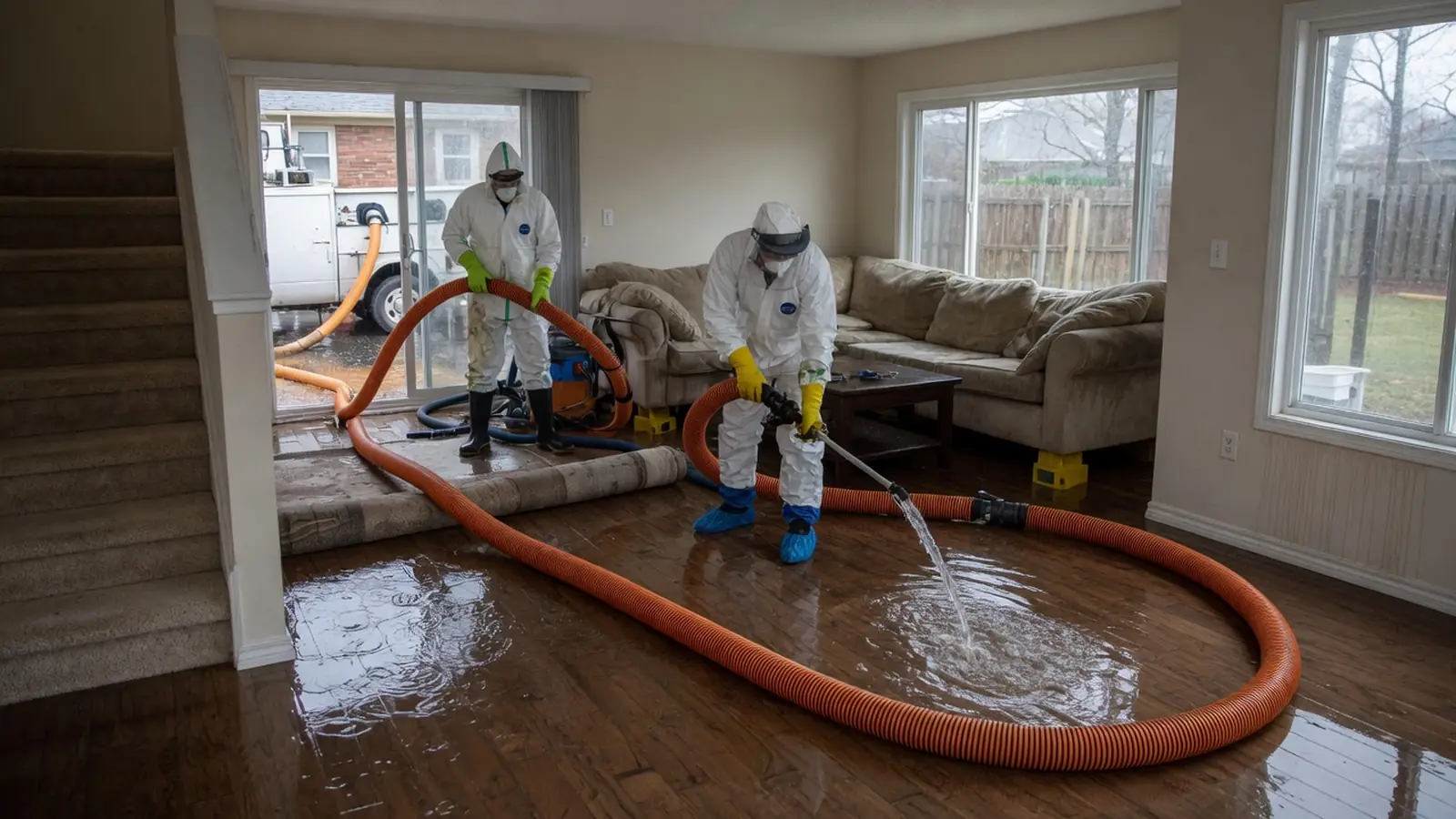
Severe 90 mph straight-line storm winds topple mature trees and splinter limbs adjacent to homes, threatening roof integrity and creating immediate water entry pathways. When sudden indoor flooding strikes, our technicians deploy commercial extraction units and rapid dehumidification systems to dry structural timber before secondary rot sets in.
If water is still coming in, call (405) 555-0167.
Prefer to talk? (405) 555-0167
Dedicated Moisture Mitigation Specialists
Homeowners discovering sudden indoor water damage often struggle to determine whether to call a plumber, roofer, or restoration professional first, so our dispatchers provide immediate phone triage to direct the proper trade specialists.
About 12% of housing units in the local area (6,629 of 55,346) were built before 1960, the era of galvanized steel supply lines and cast iron drains.
About 9% of housing units across our regional territory (5,159 of 55,346) were built in the 1960s, overlapping the years aluminium branch wiring was installed.
About 33% of housing units in our service footprint (18,000 of 55,346) were built in the 1970s and 1980s, overlapping the years polybutylene supply piping was commonly installed.
About 54% of housing units in this municipality (29,788 of 55,346) were built before 1980, the period when asbestos-containing materials and lead paint were still in use.
Review our proven storm damage repair procedures to see how our certified crews protect interior rooms when structural barriers fail.
Our crew uses penetrating pin probes and infrared thermography to map hidden water travel behind baseboards and beneath subfloors before drying begins.
We maintain clean containment zones and HEPA air filtration throughout each mitigation job to protect indoor air quality.
Step-by-Step Structural Recovery
A pattern echoed in public discussions is that moisture collecting inside below-slab HVAC ductwork leaves property owners unsure whether water originates from a foundation plumbing leak or high groundwater, but our detailed flood cleanup protocol quickly diagnoses moisture pathways and extracts standing liquid before structural assemblies degrade.
- Emergency Thermal Inspection. Our technicians inspect the property with non-invasive infrared cameras and calibrated moisture meters to establish exact drying boundaries across affected drywall and subfloors.
- High-Volume Water Extraction. We deploy commercial truck-mounted extraction units and weighted floor tools to remove standing water quickly, drastically reducing drying times for structural members.
- Industrial Evaporative Drying. Residents experiencing interior flooding often seek validation on standard industry practices regarding the placement and duration of commercial dehumidifiers and air movers, which is why our certified crews adhere strictly to IICRC S500 psychrometric guidelines for equipment density and run cycles.
- Daily Moisture Verification. Technicians return daily to log psychrometric readings and relative humidity percentages until wood framing and drywall assemblies achieve certified equilibrium dry standards.
Disciplined Structural Moisture Control
As seen during regional severe weather events, multi-day grid blackouts paired with near triple-digit summer heat disable HVAC systems, rapidly escalating humidity and mold proliferation following storm water intrusion. We maintain dedicated mobile generator units and high-capacity desiccant systems to sustain continuous structural drying regardless of local power grid failures.
Hail Impact And Storm Extraction
NOAA radar recorded 3,107 hail signatures within about 15 miles of this region between 2021-2025 (2021: 259, 2022: 649, 2023: 528, 2024: 669, 2025: 1,002). The heaviest recent hail year around our territory was 2025, with 1,002 radar hail signatures inside a 15-mile radius, frequently puncturing roof barriers and saturating attics. Our emergency crew extracts trapped moisture and protects framing from progressive deterioration.
Sub-Slab And Foundation Mitigation
The dominant mapped soils in this region (OK027) by acreage are Stephenville-Darnell-Newalla complex, 3 to 8 percent slopes; Harrah fine sandy loam, 5 to 8 percent slopes; Stephenville-Darnell complex, 1 to 5 percent slopes; Harrah fine sandy loam, 5 to 8 percent slopes, moderately eroded. The single most extensive soil unit mapped around this territory is Stephenville-Darnell-Newalla complex, 3 to 8 percent slopes, covering about 61,125 acres of OK027. Variable soil permeability shifts subsurface water tables against concrete foundations, so our technicians pump and dry water intruding through foundation slabs and subterranean ductwork.
Insurance Loss Stabilization
Homeowners frequently question whether homeowners insurance requires immediate mitigation like roof tarping before an adjuster inspects storm water damage. Policy terms universally require policyholders to prevent secondary damage, so our team performs immediate emergency tarping, moisture extraction, and thorough digital documentation for insurance claims.
Our Commitment To Certified Structural Drying
We follow strict psychrometric drying protocols to return wet building materials to pre-loss moisture equilibrium. Our technicians deploy industrial extraction equipment, low-grain refrigerant dehumidifiers, and high-velocity air movers while tracking moisture content daily with calibrated meters.
- 12Zip Codes Served
- 8Service Areas
- 3Services Offered
Read verified feedback from local homeowners who experienced our emergency water extraction and structural drying services.
“When an overhead supply line split, the team extracted the water and made clean, perfectly straight baseboard flood cuts throughout the hallway. The replacement drywall joints and finished seams lined up flush with the original plaster without any visible taping ridges. Their attention to physical alignment turned a stressful flood into a clean recovery.”
Greg H.
“After discovering water pooling near our water heater closet, the crew provided a detailed itemized quote covering equipment setup and drying runtimes before starting. Every psychrometric monitoring visit was billed exactly according to that initial written estimate without hidden fees or surprise change orders. Knowing our exact costs upfront gave my family complete peace of mind.”
Valerie C.
“Every single evening before leaving our home, these technicians rolled up extension cords, emptied condensate collection buckets, and swept the workspace clear. They kept lay-flat drying ducting neatly positioned out of main family walkways so our children could move around safely. That daily neatness made living through structural drying completely manageable.”
Arthur B.
“Throughout four days of industrial drying, the crew texted daily psychrometric moisture logs and timber meter photos directly to my cell phone every morning. I never had to hunt anyone down for updates because their lead technician proactively walked me through moisture drop percentages after every inspection. Their consistent daily communication kept our insurance adjuster fully informed without any delays.”
Colleen W.
Frequently Asked Questions
How long does the structural drying process usually take?
Complete structural drying typically takes three to five days depending on the volume of water, affected materials, and ambient relative humidity. Dense materials like subfloors and insulated wall cavities may require additional airflow.
Does homeowners insurance require roof tarping before adjuster inspection?
Yes, homeowners insurance policies require prompt mitigation including roof tarping to prevent additional rain entry before adjuster inspection. Failing to protect open penetrations can void coverage for subsequent interior saturation.
What causes water to collect inside below-slab HVAC ductwork?
Water inside below-slab ducts originates from pressurized plumbing slab leaks, rising groundwater tables, or compromised perimeter drainage lines. Immediate diagnostic testing determines whether plumbers or drainage specialists are needed.
Why do pre-1980 homes require testing before wall demolition?
Homes built before 1980 require hazardous material testing because disturbing wet drywall, vinyl, or plaster may release lead paint or asbestos. Professional containment safeguards occupants before technicians remove non-salvageable materials.
Can water-damaged drywall and baseboards be restored without replacement?
Drywall and baseboards can be saved if non-contaminated water is extracted quickly and commercial dehumidification begins within twenty-four hours. Materials showing delamination, fungal growth, or sewage contamination must be removed.